When most people hear "3D printing," they picture a desktop plastic printer slowly producing trinkets, phone cases, or a rough prototype. That image isn't wrong, but it barely scratches the surface.
In industrial settings the story is completely different. We're talking about lightweight rocket components, custom titanium hip implants, and parts that simply couldn't be made any other way. Additive Manufacturing (AM) is quietly changing how a lot of things get built.
So what does someone in this field actually do all day?
Traditional manufacturing is subtractive. You start with a solid block and cut away everything that isn't the part. AM works in reverse. You build the component up, one layer at a time. It sits somewhere between digital design, materials science, and precision engineering, and doing it well means being comfortable in all three.
Here's a look at what that involves.
Designing things that "shouldn't" be possible
AM professionals lean on Design for Additive Manufacturing (DfAM) and generative design tools to create internal lattices and hollow structures you could never machine. The payoff is real. Parts can come out up to 60% lighter while holding the same strength, and a 20 piece assembly can sometimes be collapsed into a single printed part.
Simulating the physics first
Before the laser ever switches on, an AM engineer runs simulations to predict thermal stress, warping, and whether the part will actually hold together. Getting this wrong is expensive, so a lot of the real work happens on screen long before anything is printed.
Working with serious materials
Industrial AM is not about basic plastics. Engineers work with titanium, nickel superalloys, high grade polymers, and technical ceramics, and they tune laser power, layer thickness, and print speed to get each one right.
Post processing and quality checks
Printing the part is only half the job. After that comes heat treatment to relieve internal stress in metals, surface finishing to hit tight tolerances, and non destructive testing to confirm the part is safe. For aerospace, medical, and automotive work, that verification step is non negotiable.
The takeaway
Additive Manufacturing isn't here to replace traditional manufacturing. It's expanding what's physically possible. The people in this field connect digital design to real world performance, and the result is products that are lighter, stronger, and more sustainable.
Thinking about where you fit in?
Whether you're an engineer wanting to upskill, a designer pushing structural limits, or a technician chasing high demand expertise, production is going digital and it's worth understanding early.
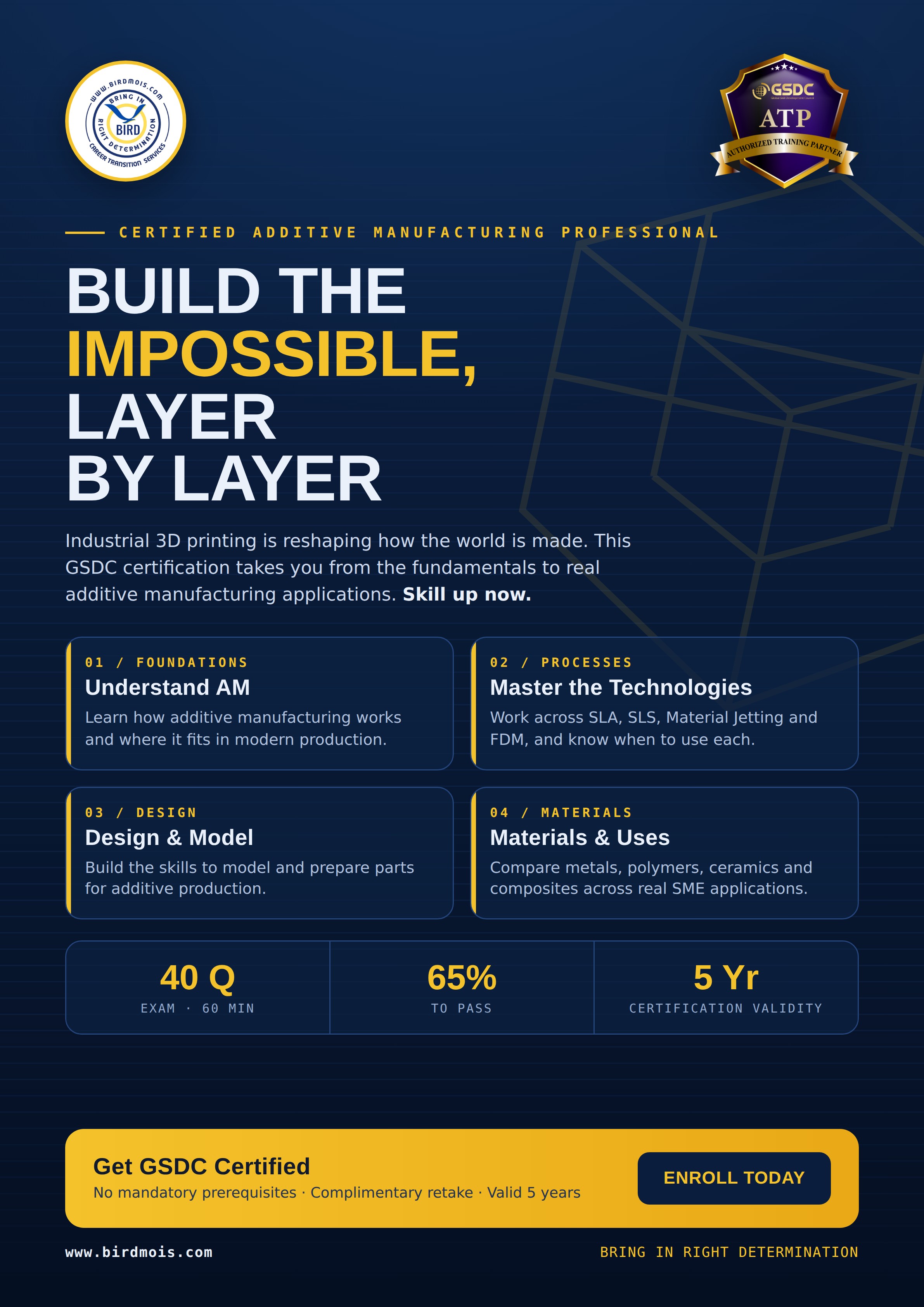
Becoming a Certified Additive Manufacturing Professional is one way to build the skills to design, build, and lead with this technology.
Learn more about certification here: https://birdmois.com/ai-certifications/certified-additive-manufacturing-professional











0 Comments