Six people team was staring at the same set of charts. Revenue, churn, conversion, the usual. Everyone could read the numbers. Everyone nodded at the graphs rising and dipping. And then one person quietly said, “The dip in March is not a problem. It is just two enterprise deals slipping into Q2, and if you look at the cohort underneath, retention is actually up.”
The room fell silent. She was right, and nobody else had seen it.
That moment captures the gap I want to talk about. For years we have repeated that data is the new oil, that every business must be data driven. And in one sense, we succeeded. Companies now collect everything. Dashboards are everywhere. The average professional has more data in front of them than an entire analytics team had fifteen years ago.
Yet most of it goes untouched, because collecting data and understanding data are two completely different skills.
Here is what I keep seeing with experienced professionals, and it is the part that frustrates me most. These are capable people. They have led teams, delivered results, and made sound decisions for years. But data literacy was not part of their training. Now they are handed a BI tool and told to let the numbers guide them. So they do the honest thing. They look at the dashboard, see revenue went up, and assume things are fine.
They are not careless. They were simply never taught to ask the second question. Why did it move, what is underneath it, and is the story the chart is telling actually the real one.
That second question is the whole job. A dashboard tells you what happened. A data practitioner tells you what it means and what to do next. One is a report. The other is judgement, and judgement is what organisations truly pay for.
The encouraging part is that this is learnable. You do not need to become a statistician or learn to code from scratch. What you need is practical literacy. Knowing how to clean data so it is trustworthy, how to apply machine learning and predictive models where they matter, and how to visualise insights so others can act on them. That is the difference between someone who shows a chart and someone who shapes a decision.
And here is the part people do not like hearing. AI has made this more urgent, not less. Many assume AI will do the thinking for them. It will not. AI will confidently produce a polished, completely misleading chart if you feed it messy data or do not know what you are looking at. The person who can tell the difference, who knows when the model is wrong, is more valuable now than ever.
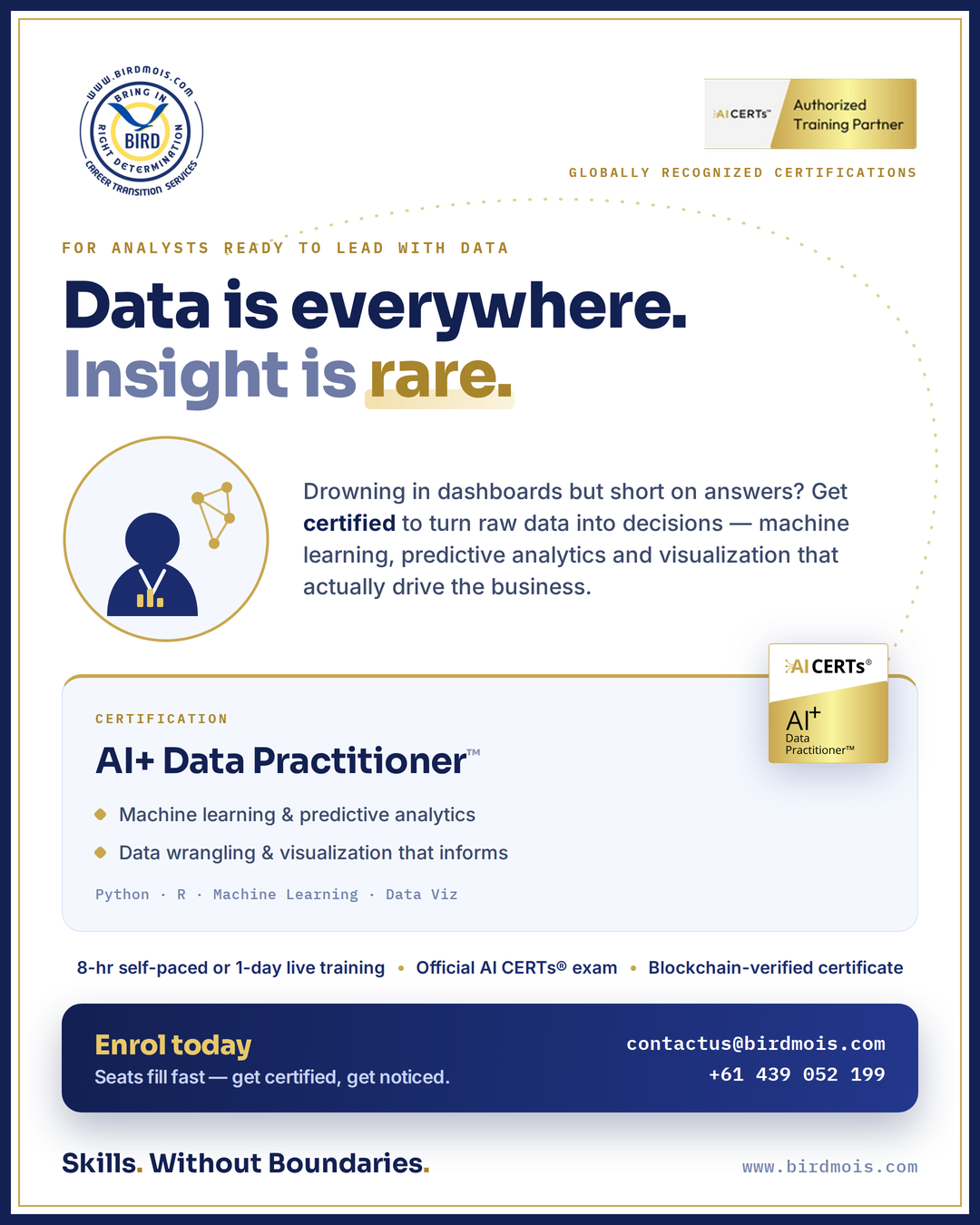
That is exactly what the AI Plus Data Practitioner certification is designed to build. Not how to open a dashboard, but the real, certifiable skill of turning raw data into decisions using machine learning, predictive analytics, and clear visualisation. It is the credential behind roles like Data Scientist and Machine Learning Engineer, created for professionals who need literacy, not a computer science degree.
Data is everywhere now. That was the easy part. Insight, knowing what the numbers actually mean, is still rare. And rare is exactly what makes you valuable.
To give an edge to your data skills and boost your own confidence in data drawn decisions, feel free to explore AI + Data Practitioner : https://birdmois.com/ai-certifications/ai-data









0 Comments