SIGN UP NOW! 18 Jan'26 - AI+ Sales™ Certification in a Day. Introductory Price of USD 399 only!
Login

Certified Chief Sustainability Officer

Certified Chief Sustainability Officer based on ESG standards to lead strategy, compliance, and sustainable growth.

Certified Chief Sustainability Officer
Price: USD $190.00

Trusted By 75000+ Professionals

Logo 1 Logo 2 Logo 3 Logo 4 Logo 5 Logo 6 Logo 7 Logo 8 Logo 9 Logo 1 Logo 2 Logo 3 Logo 4 Logo 5 Logo 6 Logo 7 Logo 8 Logo 9

About Certified Chief Sustainability Officer

Objective Of Chief Sustainability Officer Certification

Understand Sustainability Principles
Integrate Sustainability into Corporate Strategy
Master Frameworks and Standards
Develop Business Case for Sustainability
Navigate Regulatory and Compliance Landscapes
Build Resilience and Risk Management
Enhance Leadership and Stakeholder Engagement
Innovate for Sustainability
Prepare for Future Sustainability Challenges
Achieve Certification as a Chief Sustainability Officer

Benefits of Chief Sustainability Officer Certificate

Gain a strategic understanding of sustainability and its impact on business.
Learn to integrate sustainability into corporate strategy and operations.
Develop advanced leadership skills for promoting sustainability.
Understand and comply with global sustainability regulations.
Identify opportunities for innovation and competitive advantage.

Exam Syllabus Of Certified Chief Sustainability Officer

  • Brundtland Report
  • Historical Context and Background
  • Key Concepts and Definitions
  • Recommendations and Implications
  • Legacy and Impact
  • Triple Bottom Line (People, Planet, Profit)
  • Social Dimension (People)
  • Environmental Dimension (Planet)
  • Economic Dimension (Profit)
  • Integrating the Triple Bottom Line
  • Corporate Social Responsibility (CSR)
  • Definition and Evolution of CSR
  • The Importance of CSR for a Chief Sustainability Officer
  • Implementing CSR: Key Strategies and Best Practices
  • Evolution and Importance of Sustainability in Business
  • Evolution of Sustainability in Business
  • Importance of Sustainability in Business
  • Case Studies and Examples
  • Global and Regional Sustainability Trends
  • Climate Action
  • Sustainable Development Goals (SDGs)
  • Circular Economy
  • Renewable Energy Transition
  • Sustainable Finance
  • The Role of Chief Sustainability Officer in Addressing Emerging Challenges & Opportunities
  • Challenges Faced by Chief Sustainability Officers
  • Opportunities for Chief Sustainability Officers
  • The Evolving Chief Sustainability Officer Role
  • Case Studies: Chief Sustainability Officers in Action

  • Linking Sustainability to Corporate Strategy
  • Strategic Integration of Sustainability
  • Benefits of Linking Sustainability to Corporate Strategy
  • Best Practices for Effective Alignment
  • Case Study: IKEA's Business Case for Sustainability
  • Financial Implications of Sustainability
  • Cost Savings
  • Revenue Generation
  • Investment Attraction
  • The Role of Chief Sustainability Officer in Business Case for Sustainability
  • Measuring and Communicating Sustainability Impact
  • Key Performance Indicators (KPIs) for Sustainability
  • Sustainability Reporting and Transparency
  • Communicating Sustainability Impact to Stakeholders

  • Sustainability Business Model
  • Types of Sustainability Business Models
  • Key Components of a Sustainability Business Model
  • Case Study - Sustainability Business Model
  • Sustainability Strategy
  • Understanding Sustainability Strategy
  • Key Components of a Sustainability Strategy
  • Case Study: Unilever's Sustainable Living Plan
  • Case Study: Singapore Airlines
  • Benefits of Sustainability Integration
  • Market Differentiation and Customer Loyalty
  • Regulatory Compliance and Access to Markets
  • Challenges and Barriers to Sustainability Integration
  • Lack of Awareness and Understanding
  • Short-Term Financial Pressures
  • Resource Constraints
  • Complex Supply Chains
  • Regulatory Uncertainty and Compliance Burdens
  • CSO's Role in Strategic Planning and Decision-Making
  • Strategic Alignment
  • Risk Management
  • Innovation and Opportunity Identification
  • Stakeholder Engagement
  • Performance Monitoring and Reporting
  • Collaboration and Integration
  • Utilizing Frameworks such as ESG and SDGs
  • ESG Framework (Environmental, Social, Governance)
  • SDGs Framework (Sustainable Development Goals)

  • Identifying Sustainability Opportunities in Product Development, Operations, and Supply Chains
  • Product Development
  • Sustainable Operations
  • Sustainable Supply Chains
  • Leveraging Sustainability for Market Differentiation
  • Brand Positioning
  • Customer Loyalty
  • Competitive Analysis
  • Innovation in Sustainable Business Practices
  • Technological Innovation
  • Process Innovation
  • Business Model Innovation

  • Overview of Key Sustainability Regulations
  • EU Green Deal
  • EU Taxonomy
  • SFDR (Sustainable Finance Disclosure Regulation)
  • CSRD (Corporate Sustainability Reporting Directive)
  • Compliance Strategies for International Standards: GRI, TCFD, SASB
  • GRI (Global Reporting Initiative)
  • TCFD (Task Force on Climate-related Financial Disclosures)
  • SASB (Sustainability Accounting Standards Board)
  • Implications of Future Regulatory Trends on Business Operations
  • Stricter Climate Regulations
  • Enhanced ESG Disclosure Requirements
  • Alignment with Global Sustainability Agendas

  • Identifying and Managing Sustainability-Related Risks
  • Environmental Risks
  • Social Risks
  • Governance Risks
  • Risk Assessment and Mitigation Strategies
  • Building Resilience to Environmental and Social Risks
  • Proactive Risk Management
  • Adaptive Capacity
  • Collaboration and Partnerships
  • Developing a Comprehensive Risk Management Framework
  • Risk Identification and Assessment
  • Risk Mitigation and Response Planning
  • Monitoring and Reporting
  • Integration into Corporate Governance
  • Continuous Improvement

  • Engaging Key Stakeholders in Sustainability Initiatives
  • Identifying Stakeholders
  • Building Stakeholder Relationships
  • Effective Communication Strategies
  • Collaboration with External Partners
  • Partnerships with NGOs and Community Organizations
  • Collaborating with Governments and Policymakers
  • Industry Collaborations for Collective Impact
  • Driving Internal Collaboration and Culture Change
  • Engaging Employees in Sustainability Efforts
  • Building a Sustainability-Oriented Culture
  • Training and Capacity Building for Employees

  • Developing Sustainability Reports
  • Purpose and Importance of Sustainability Reporting
  • Key Elements of an Effective Sustainability Report
  • Case Study: Best Practices in Sustainability Reporting
  • Communicating Sustainability Performance to Stakeholders
  • Targeted Communication for Different Stakeholders
  • Use of Digital Platforms and Social Media
  • Transparency and Authenticity in Communication
  • Leveraging Sustainability Certifications and Standards
  • Overview of Key Certifications (e.g., LEED, ISO 14001)
  • Benefits of Sustainability Certifications

  • Setting and Monitoring KPIs
  • Identifying Relevant KPIs
  • Setting Realistic and Measurable Targets
  • Monitoring and Reporting Progress
  • Utilizing Data Analytics and Technology for Impact Measurement
  • Tools for Sustainability Analytics
  • Leveraging AI and IoT in Sustainability
  • Interpreting and Acting on Sustainability Data
  • Benchmarking Sustainability Performance
  • Comparing Against Industry Standards
  • Identifying Areas for Improvement
  • Continuous Improvement Through Benchmarking

  • Emerging Trends in Sustainability
  • Climate Tech and Innovation
  • Decarbonization and Net-Zero Initiatives
  • ESG Investing and Sustainable Finance
  • Preparing for Future Challenges and Opportunities
  • Resilience in the Face of Climate Change
  • Evolving Consumer Expectations
  • The Role of Technology in Shaping Sustainability
  • Vision for Sustainability 2030 and Beyond
  • Global Goals and Commitments
  • The Role of Businesses in Achieving a Sustainable Future

  • Background - As the Chief Sustainability Officer (CSO), you have worked closely with a Sustainability Consultant to complete the organization’s Sustainability Report for the Year 2024. The report is now ready, and your task is to present it to the Board of Directors to obtain their approval for public release. This assignment requires you to summarize and extract key elements from the finalized report, demonstrating your ability to present sustainability performance and strategic insights to the Board clearly and persuasively.
  • Objective - Your objective is to develop a Board of Directors report that outlines the key findings from the organization's Sustainability Report. You must clearly explain the sustainability strategy, achievements, stakeholder engagement, and how the report aligns with corporate goals. The aim is to convince the Board that the Sustainability Report is ready for public release.
  • Scope - You may choose any organization that has published its latest sustainability report (preferably your organization) and use that as a reference to summarize the key components. The report should focus on environmental, social, and governance (ESG) aspects, compliance with global sustainability frameworks, and how the report addresses stakeholder concerns.

  • No Copy - Pasting You are not allowed to copy and paste the entire Sustainability Report into your assignment. Instead, extract and summarize the key points that are most relevant for the Board of Directors' review.
  • Focus on Key Elements - Marks will be awarded for your ability to clearly present and summarize the key elements of the report in a way that is concise, strategic, and suitable for Board-level discussion.
  • Page Limit - The report must be between 20 to 40 pages (excluding appendices). Marks will be deducted for exceeding 40 pages. The appendices will not count toward the page limit.

  • Executive Summary - Provide a concise and engaging summary of the 2024 Sustainability Report, including key achievements, challenges, and recommendations for the Board’s approval.
  • Introduction - Background on the organization’s sustainability strategy, the role of the CSO, and how the 2024 Sustainability Report was developed in collaboration with the Sustainability Consultant.
  • Sustainability Performance Overview - Summarize the organization’s environmental, social, and governance (ESG) performance, focusing on key achievements and challenges. Highlight specific goals from the report and explain why these goals are achievable.
  • Stakeholder Engagement - Detail how key stakeholders were engaged during the creation of the Sustainability Report (e.g., employees, customers, investors, suppliers). Demonstrate how their feedback influenced the report and highlight the organization’s commitment to transparency and accountability.
  • Compliance and Alignment with Global Standards - Discuss how the Sustainability Report aligns with global sustainability frameworks such as the SDGs, ESG criteria, or GRI standards, and explain the organization’s commitment to these standards.
  • Risk and Opportunity - Assessment Provide an analysis of potential risks and opportunities associated with releasing the report to the public. This could include reputational risks, regulatory implications, or opportunities for growth and stakeholder engagement.
  • Key Goals and Achievability - Highlight specific goals from the Sustainability Report and justify their achievability. Use performance data and strategic initiatives to demonstrate why these goals can be realistically met in the short- and long-term.
  • Recommendations for Approval - Present clear recommendations for the Board to approve the Sustainability Report for public release. Include any final adjustments or enhancements that might be necessary before publication.
  • Conclusion - Summarize the key arguments for approving the report, emphasizing the importance of transparency, alignment with long-term goals, and how releasing the report will enhance stakeholder trust and corporate reputation.

  • Clarity and Presentation: The quality and clarity of your report in addressing the Board ensure that key sustainability elements are presented coherently.
  • Strategic Insight: The strategic analysis of sustainability performance, risks, opportunities, and goal-setting.
  • Stakeholder Engagement: The depth of your engagement strategy and how effectively you demonstrate stakeholder influence on the report.
  • Risk and Opportunity Assessment: How well you identify potential risks and opportunities associated with the report’s public release.
  • Goal Justification: The strength of your rationale behind the achievability of the goals highlighted in the Sustainability Report.
  • Use of Data and Metrics: The effectiveness of using data and metrics to support your recommendations and analysis.

  • Format: Submit the report in a professional format suitable for board-level review, in PDF or Word format.
  • Length: The report should be 20 to 40 pages in length, excluding appendices. Marks will be deducted for exceeding the page limit.
  • Visual Aids: Include relevant charts, graphs, and tables to enhance the clarity of your presentation and support your analysis.
  • By completing this assignment, you will demonstrate your ability to summarize and present complex sustainability data to executive stakeholders. Successfully passing this assignment will earn you the esteemed Certified Chief Sustainability Officer certification.

  • To pass this assignment, learners must achieve at least 70% of the total marks. Marks will be allocated to various sections based on the quality and depth of analysis. Below is the breakdown of the marking criteria and the corresponding scoring bands:
  • Clarity and Presentation – 20 Marks: Evaluation of the organization, clarity, and coherence of the report. Strong focus on the effectiveness of data visualization (charts, tables) and overall presentation.
  • Strategic Insight – 20 Marks: Analysis of how well the sustainability performance, risks, opportunities, and goals align with the organization's long-term strategy and sustainability principles.
  • Stakeholder Engagement – 15 Marks: Depth and relevance of the stakeholder engagement strategy. Clear demonstration of how stakeholder input shaped the Sustainability Report and key decisions.
  • Risk and Opportunity Assessment – 15 Marks: Thorough identification and analysis of risks and opportunities related to the report's public release, including potential reputational and regulatory impacts.
  • Goal Justification – 10 Marks: Rationale for the achievability of sustainability goals based on performance data and strategic initiatives. Strong justification and evidence-based reasoning are required.
  • Use of Data and Metrics – 10 Marks: Effective use of data and metrics in presenting sustainability performance and backing up recommendations. This includes analysis of environmental, social, and governance (ESG) metrics.
  • Recommendations for Approval – 10 Marks: Clear, concise, and actionable recommendations that effectively convince the Board to approve the Sustainability Report for public release.
Self-Paced Online
Expert Led Videos - 10 hrs of learning
Get 1 Certification - Just $1600
Save up to 50% with our limited-time offer!
3 SME Connect (1-on-1)
Access to GSDC AI Studio
Weekly Group SME Connect Session
Certification Exam + 1 Free Retake & Practice
Capstone Project + AI Interview & Tools
GSDC Membership worth $109 free
Course Price: USD $190.00
Purchase Self-Paced Course

Download Brochure

Looking to enroll your employees into this program?

Download Brochure
Moneyback Guarantee

30-Day Money-Back Guarantee

Target Audience

Target Audience For Sustainability Officer Certification

CEOs and C-suite executives
Senior leaders responsible for corporate strategy and operations
Heads of departments such as CSR/Sustainability, Risk Management, Finance, HR, Marketing, Supply Chain, and Operations
Corporate Social Responsibility (CSR) Leads
Environmental Compliance Officers
Supply Chain Sustainability Specialists
Governance and Ethics Officers

Pre-Requisites For Chief Sustainability Officer Certificate

Prior knowledge or experience in sustainability or ESG domains is recommended but not mandatory for taking the GSDC Sustainability Officer Certification exam

Exam Details Of Certified Chief Sustainability Officer

Exam Questions
40
Exam Format
Multiple choice
Language
English
Passing Score
70%
Duration
60 min
Open Book
No
Certification Validity
5 Years
Complimentary Retake
Yes

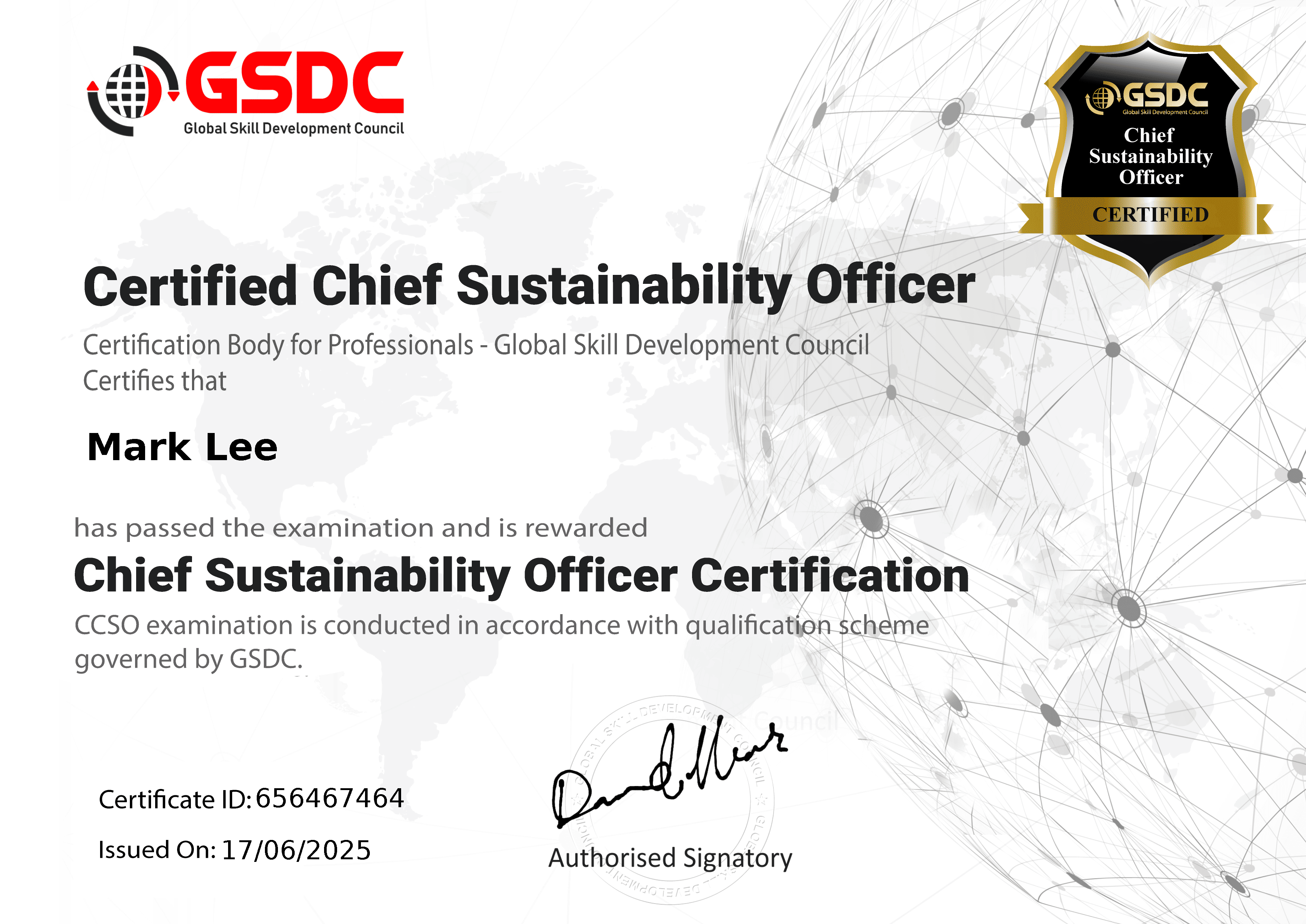
Sample Certification

Generative AI Expert Certification Image

About Chief Sustainability Officer Certification

Become a leader in sustainability with our Certified Chief Sustainability Officer course.

Designed for professionals aiming to drive impactful change within organizations, this comprehensive program covers essential topics from understanding sustainability principles to integrating them strategically into corporate strategy.

You will gain insights into the business case for sustainability, discovering how it aligns with corporate strategy and drives financial benefits such as cost savings and revenue generation.

Through case studies and practical exercises, you'll develop a deep understanding of sustainability business models and strategies, equipping you to identify opportunities for innovation and competitive advantage.

Our course emphasizes practical skills in risk management, stakeholder engagement, and transparent communication through sustainability reporting, essential for navigating regulatory landscapes and building resilient, future-ready organizations.

Upon completion, you'll emerge as a Certified Chief Sustainability Officer ready to lead with integrity, influence stakeholders effectively, and champion sustainability initiatives that create enduring value for businesses and communities alike.